Friday, 9 October 2026Melbourne, AustraliaFive minutes, sourced
The Friday Intelligence Briefing
Plain · Sourced · Every Friday
The Build BriefIssue 013
Victoria's housing starts reached their highest level since March 2023.
Victoria started 16,239 homes in the June quarter and national starts rose 7.0%, while annual completions in Victoria barely changed. The state's building contract reforms must now start by 31 March 2027, not 1 December 2026. This week's Feature shows what a BuilderHQ cost estimate contains.
By BuilderHQ, Melbourne
New on BuilderHQThe Build Brief · Issue 013
BuilderHQ now prepares cost estimates for practices, builders and homeowners.
Our estimating team prepares each estimate from the project's drawings. It gives a low, most likely and high total, a trade-by-trade breakdown and the assumptions behind the figures.
Architects and designers can request one for a client. Builders can request one for a job they are pricing. Homeowners can add one to their tender.
Victoria's housing starts rose while completions stayed flat.
Victoria had its strongest quarter of housing starts since March 2023, while completions over the year barely moved. More homes are now under construction at once. That affects anyone waiting on trades, inspections or a handover.
We also have a correction. Four earlier editions said Victoria's building contract reforms would start by 1 December 2026. The latest start date is now 31 March 2027. Market Watch 02 sets out which rules apply in the meantime.
Market Watch 03 looks at the 5% Deposit Scheme and what the Reserve Bank says about negative equity. The Feature shows what a BuilderHQ cost estimate contains.
The BuilderHQ Team
Market Watch
Three signals this week.
Market Watch · Signal 1 of 3For everyone in the build
01 · The Pipeline
Victoria started 16,239 homes in the June quarter, while annual completions barely changed.
16,239
homes started in Victoria in the June quarter, seasonally adjusted
the most since March 2023
Victoria, homes started and completed over 12 months
Starts+1,593
Year to June 202555,958
Year to June 202657,551
Completions+7
Year to June 202556,296
Year to June 202656,303
Rolling 12-month totals of seasonally adjusted ABS data, summed by the Property Council of Australia. Before seasonal adjustment, completions fell slightly. The June figures are preliminary and will be revised on 13 January 2027. The axis starts at zero.
Victoria, homes started and completed over 12 months. Over 12 months, starts rose from 55,958 to 57,551. Completions rose from 56,296 to 56,303, a difference of seven.
Series
Homes
Starts, Year to June 2025
55,958
Starts, Year to June 2026
57,551
Completions, Year to June 2025
56,296
Completions, Year to June 2026
56,303
Seasonally adjusted, the June quarter was Victoria's strongest for housing starts since March 2023. Victoria accounted for about 31% of all homes started in Australia.
Completions barely changed. Victoria completed 56,303 homes in the 12 months to June, against 56,296 in the 12 months before. With starts rising and completions flat, more homes are under construction at once.
Nationally, starts rose 7.0% to 52,201, led by an 11.6% rise in private house starts. Private starts of apartments, townhouses and other attached homes were flat, down 0.1%. Across Australia, 248,733 homes were under construction at the end of June.
The stronger quarter does not settle concerns about the years ahead. On 1 October, Master Builders Australia cut its forecast to fewer than 920,000 starts over the five years to 2030-31, 8.4% below its March forecast. The June figures also predate the Reserve Bank's 29 September rate rise, its fourth this year, which took the cash rate to 4.60%.
Longer builds keep construction loans in drawdown for longer. Allow for that when you set facility terms.
Source: ABS, Building Activity, Australia, June 2026 (7 October 2026) · Property Council of Australia (7 October 2026) · Master Builders Australia (1 October 2026) · Reserve Bank of Australia (29 September 2026).
Market Watch · Signal 2 of 3For everyone in the build
02 · The Rules
Victoria has moved its building contract reforms to 31 March 2027.
31 Mar 2027
latest start date for Victoria's domestic building contract reforms
previously 1 December 2026
The dates
Regulations to be madeOctober 2026
Caretaker period expected to begin3 November 2026
Latest start date31 March 2027
Earlier editions of The Build Brief reported that these reforms would start by 1 December 2026. That date has changed. The correction is at the foot of this edition.
The Consumer Legislation Amendment Act 2026, passed in September, moved the latest start date for the Domestic Building Contracts Amendment Act 2025 to 31 March 2027. The reforms could start earlier if the government proclaims an earlier date, but its published timeline gives 31 March 2027 for both the Act and the new deposit and progress payment regulations.
What applies now. The contract changes apply only to contracts signed on or after they start. Until then, the current rules apply, including deposit caps of 10% for contracts under $20,000 and 5% for contracts of $20,000 or more.
The caretaker period before the state election, when the government generally defers major decisions, is expected to begin at 6pm on Tuesday 3 November.
Which rules apply to a Victorian domestic building contract
Signed before the reforms start
Signed on or after they start
Deposit
10% under $20,000, 5% at $20,000 and over
Proposed caps of 10%, 15% or 20%, by offsite share
Progress payments
Current stages
Proposed new stages, including site preparation
Major contract threshold
$10,000
Proposed $20,000
Variations
Current process
One process, set in the Act
Which rules apply to a Victorian domestic building contract
Series
Signed on or after they start
Deposit: Signed before the reforms start
10% under $20,000, 5% at $20,000 and over / Signed on or after they start: Proposed caps of 10%, 15% or 20%, by offsite share
Progress payments: Signed before the reforms start
Current stages / Signed on or after they start: Proposed new stages, including site preparation
Major contract threshold: Signed before the reforms start
$10,000 / Signed on or after they start: Proposed $20,000
Variations: Signed before the reforms start
Current process / Signed on or after they start: One process, set in the Act
Market Watch · Signal 3 of 3For everyone in the build
03 · The Buffer
More than 102,000 first home buyers used the expanded 5% Deposit Scheme in its first year.
33,413
of them in Victoria, about a third of the national total
102,594 nationally
Home values, Cotality index
National values below the March 2026 record high5.2%
Monthly falls in a row, to September6
The 5% Deposit Scheme was expanded on 1 October 2025. In its first year, 102,594 first home buyers used it, according to Housing Australia figures released by the Government on 1 October.
That is a large group of buyers entering the market with small deposits while home values ease.
The Reserve Bank estimates that fewer than 1% of mortgage borrowers owe more than their home is worth, known as negative equity. In a scenario where prices fell a further 20% across the board, it estimates about 5% of mortgages would. That is a stress test, not a forecast.
The Bank notes that recent buyers and borrowers with smaller deposits are more likely than others to be in negative equity.
For anyone building, the valuation at completion matters. A construction loan is usually valued "as if complete", so softer sales during the build can mean a lower final valuation. A small deposit leaves less room to absorb it.
Negative equity, Reserve Bank estimates
Under 1%
of mortgage borrowers in negative equity now
About 5%
of mortgages in a scenario where prices fell a further 20%
The figures cover all mortgages, not only buyers in the scheme.
Negative equity, Reserve Bank estimates. Fewer than 1% of mortgage borrowers are in negative equity now. In a scenario where prices fell a further 20% across the board, about 5% of mortgages would be.
Series
Share
of mortgage borrowers in negative equity now
Under 1%
of mortgages in a scenario where prices fell a further 20%
For low-deposit construction clients, model the equity position at completion as well as repayment capacity.
Source: Prime Minister and Minister for Housing, joint release, 1 October 2026 (Housing Australia data) · Reserve Bank of Australia, Financial Stability Review, October 2026 · Cotality, Home Value Index, 1 October 2026.
The FeatureThe Build Brief · Issue 013
What a BuilderHQ cost estimate contains, and who can get one.
A preliminary estimate, prepared from the drawings before builders price the project.
"What will it cost?" is usually asked before anyone has priced the drawings. A cost estimate gives an answer while the design can still change, and a figure to check builders' prices against when they arrive.
Three totals
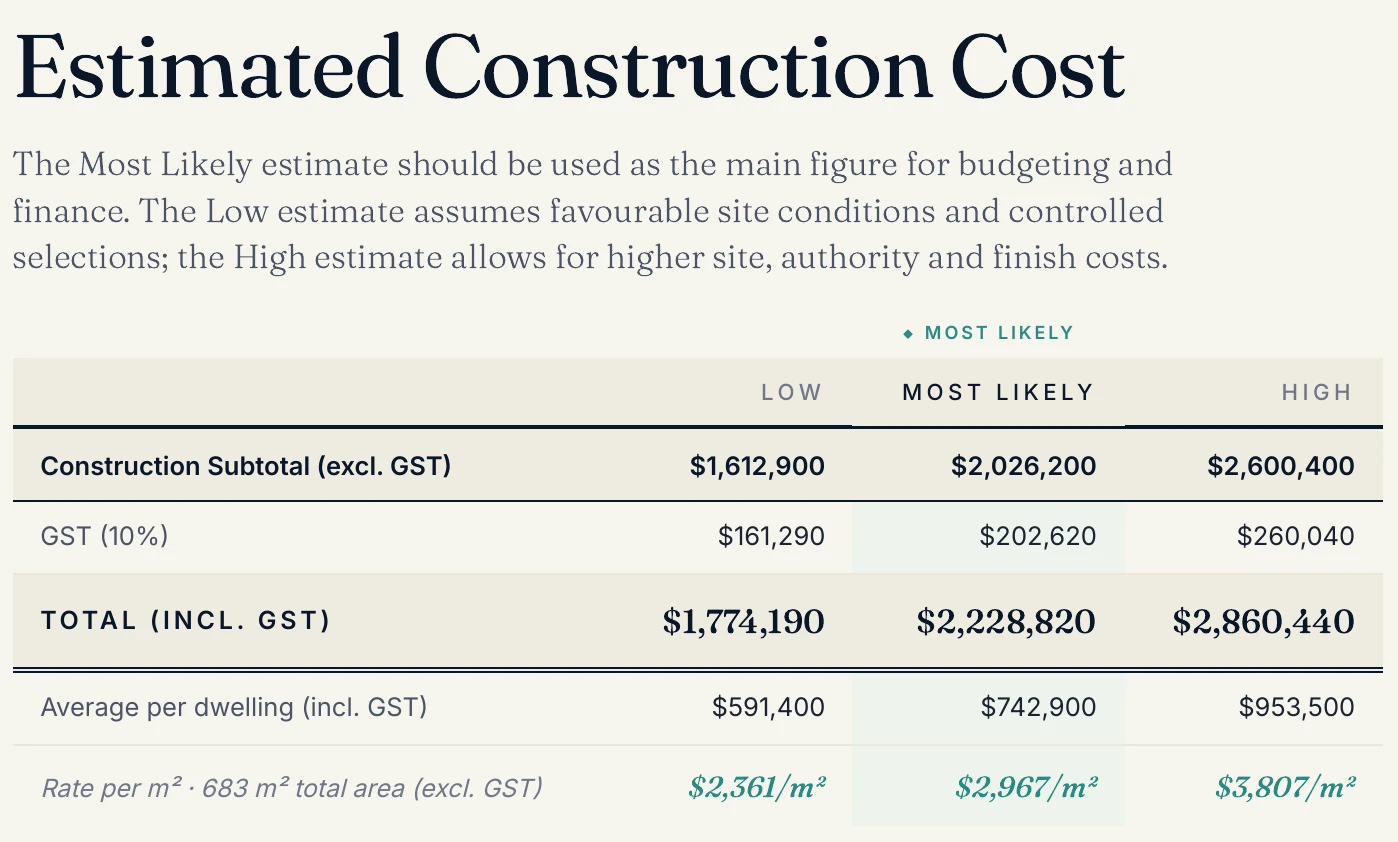
Each estimate gives a Low, Most Likely and High total. The Most Likely figure is the one to budget and finance against. Low assumes favourable site conditions. High allows for higher site, authority and finish costs.
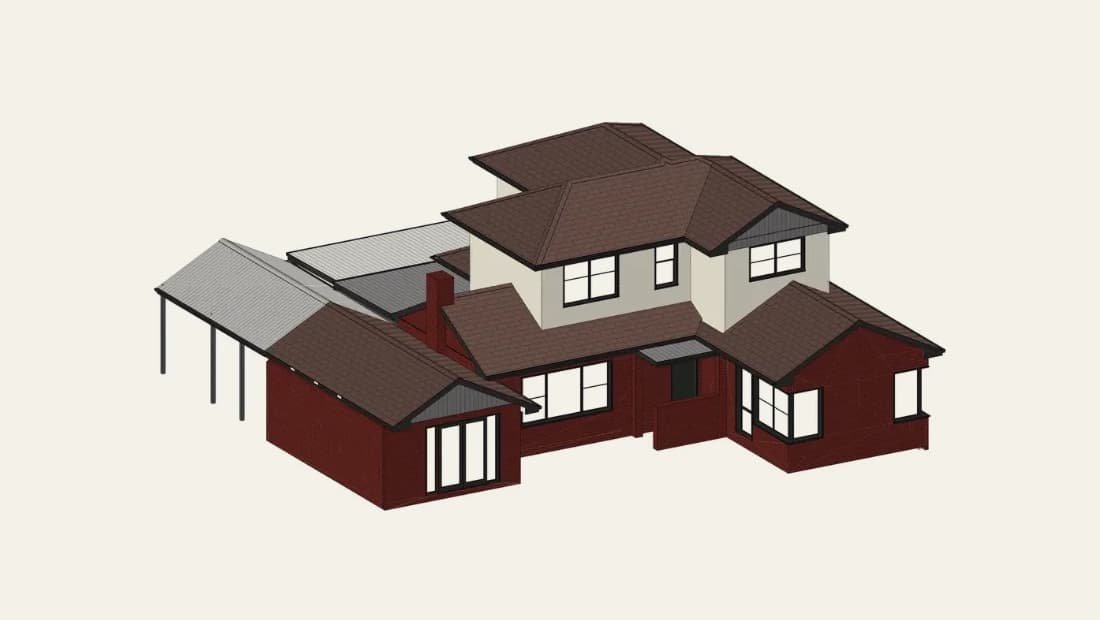
Our example covers three double-storey townhouses in Melbourne, 683 m² in total. Its Most Likely figure works out at $2,967 per m² before GST. Our estimates have an average expected accuracy of about plus or minus 10%.
The example estimate, including GST
$1,774,190
Low
$2,228,820
Most Likely
$2,860,440
High
Three townhouses, 683 m² of floor area including garages. Before GST, the totals are $1,612,900, $2,026,200 and $2,600,400.
The example estimate, including GST. Low $1,774,190, Most Likely $2,228,820 and High $2,860,440, including GST.
Series
Total including GST
Low
$1,774,190
Most Likely
$2,228,820
High
$2,860,440
Every trade, priced
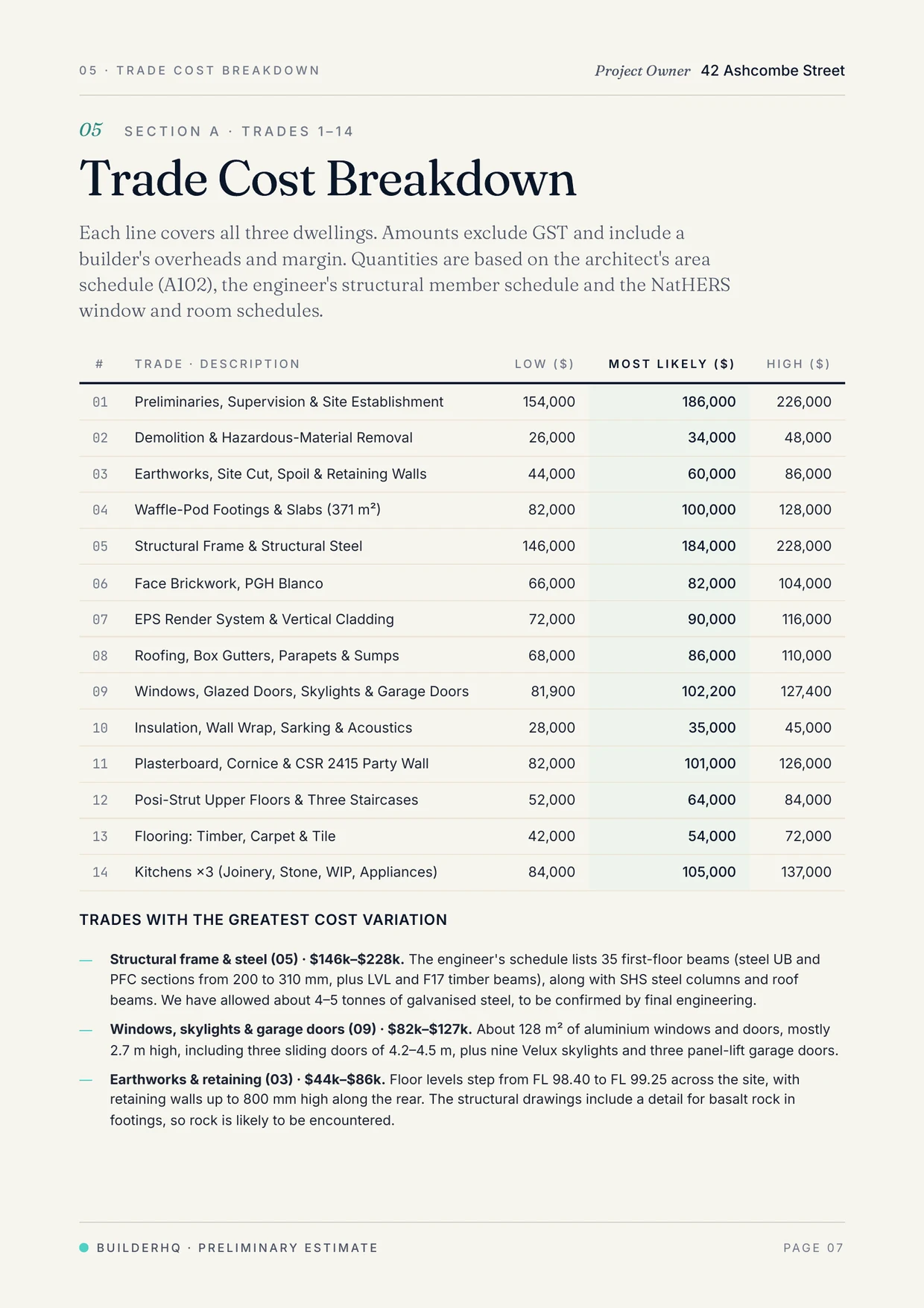
The example lists 25 trades, each with a low, most likely and high amount, and the lines add up exactly to the totals. Prime cost items and provisional sums, the allowances for items not yet chosen or measured, sit inside those lines rather than on top.
Page 7 of the example estimate: trades 1 to 14 of 25. Amounts exclude GST and include a builder's overheads and margin.
What else is inside
The example runs to 17 pages.
01Project OverviewSite, dwellings and documents reviewed
02Dwelling OverviewAreas and indicative cost for each dwelling
03Estimated Construction CostLow, Most Likely and High, including GST
04Cost DistributionCost by category of work
05Trade Cost Breakdown25 trades covering all three dwellings
06Prime Cost and Provisional SumsThe allowances included
07Scope, Inclusions and ExclusionsWhat is included, provisional or excluded
08Key Risks, Payments and ProgrammeRisks, payment stages and timing
09Basis of EstimateDocuments, assumptions and sources
10Requirements for a Fixed PriceWhat a builder needs to confirm a fixed price
Who can request one
Architects and designers. Request one for a client's project from the practice dashboard. It stays private to the practice, and the project can move into a tender in one step.
Builders. Request one for a job you are pricing, on BuilderHQ or from drawings you upload yourself.
Homeowners. Add one to your tender, prepared from the same drawings and scope the builders price.
How it is prepared
An estimator from our team works through the drawings. Floor plans and elevations are enough to start. Questions come through the request page, and the expected date is shown before the request is sent.
What it is not
It is not a quote, a tender or a cost plan. Builders' prices will vary with the final documents, site conditions, the market and the contract.
A Low, Most Likely and High range gives an early figure to test borrowing capacity against, before a builder's price arrives.
Source: BuilderHQ, October 2026 · BuilderHQ example estimate.
Partner CornerThe Build Brief · Issue 013
Meet SilverPoint, and a first-floor addition in Sandringham.
Building design & Town planning · Camberwell, VIC · In the network since 2026
Building design and planning practice · Camberwell, VIC
4.9★
Google rating, 72 reviews
1,800+
Projects completed
40+ yrs
In Melbourne
Why we introduce them
SilverPoint handles building design and town planning in one office, so each design is shaped around what the council is likely to approve.
The practice
A Camberwell practice that has worked across Melbourne for more than 40 years. It designs new homes, extensions, dual occupancies and townhouses, and prepares planning applications and subdivisions.
A practice that carries a project from the first design to builder selection is one we want in front of people planning a build.
The family had outgrown their Sandringham home, but with the children settled at school, moving was not an option. The site left little room to build out, so SilverPoint designed a first floor above the existing house.
The new floor follows the style of the original home, so it reads as part of the house rather than an addition.
The ATO will stop accepting credit cards after 30 November 2026. Debit cards are still accepted. If a payment plan is paid by direct debit from a credit card, change the payment method before the first instalment due after 30 November. The September-quarter BAS is the last quarterly BAS that can be paid directly by credit card.
Victoria updates its residential codes while the four-home pathway waits.
Planning Victoria has said applications for up to four homes on a lot would be assessed in 10 business days from October. As of 9 October, that change has not taken legal effect and has no start date. Separately, Amendment VC315 took effect on 24 September. It refines the Single Home Code, the Townhouse and Low-Rise Code and the Mid-Rise Code, including the tree canopy and stormwater standards. Check designs prepared before then against the updated codes.
QuestionsThe Build Brief · Issue 013
Questions this edition answers
What is the difference between housing starts and completions?
A start, which the ABS calls a commencement, is counted when building work begins on site. A completion is counted when the home is finished. Starts show work entering the pipeline. Completions show homes leaving it.
When do Victoria's new domestic building contract rules start?
By 31 March 2027 at the latest. The Consumer Legislation Amendment Act 2026 moved the deadline from 1 December 2026, and the Victorian Government's timeline gives 31 March 2027 for the Act and the new regulations. The changes apply only to contracts signed on or after they start.
What does negative equity mean?
A borrower is in negative equity when their loan is larger than the value of their home. The Reserve Bank estimates that fewer than 1% of Australian mortgage borrowers are in that position. In a modelled scenario where prices fell a further 20% across the board, about 5% of mortgages would be.
Can businesses pay the ATO by credit card after 30 November 2026?
Yes, until 30 June 2027. The ATO had said it would stop accepting credit cards after 30 November 2026, but on 9 October 2026 the government announced it will keep accepting them until 30 June 2027.
Is a preliminary cost estimate a quote?
No. It gives Low, Most Likely and High totals prepared from the drawings. It is not a quote, a tender or a cost plan, and builders' prices will vary with the final documents, site conditions and contract.
Correction
Issues 002, 006, 007 and 012 reported that Victoria's domestic building contract reforms would start by 1 December 2026. That date has changed. The reforms must now start by 31 March 2027, and the Victorian Government's timeline gives that date for both the Domestic Building Contracts Amendment Act 2025 and the new deposit and progress payment regulations.
This edition used data and reporting from the Australian Bureau of Statistics, the Property Council of Australia, Master Builders Australia, the Victorian Government, Consumer Affairs Victoria, the Reserve Bank of Australia, the Prime Minister and the Minister for Housing, Housing Australia, Cotality and the Australian Taxation Office. The Build Brief is compiled by BuilderHQ, Melbourne.
Over to you
What would you most like The Build Brief to help you understand?
Reply with a line. The topics readers ask about most shape where we take future editions.
Victoria's housing starts reached their highest level since March 2023, while annual completions barely changed. Victoria's building contract reforms must now start by 31 March 2027. And what a BuilderHQ cost estimate contains. This week's Build Brief.